
Cedar vs Vinyl Siding for Long Island Homes
Cedar looks beautiful. Vinyl is practical. But which one actually holds up on Long Island — and which one makes sense for your home, your budget, and your neighborhood?
If you’ve been staring at your siding and wondering whether it’s time to replace it — and what to replace it with — you’re not alone. For most homeowners across Suffolk County, the choice comes down to cedar or vinyl. Both are popular here. Both have real advantages. And both can fail if installed poorly or chosen for the wrong reasons. Before you get three quotes and pick the middle one, it helps to understand what you’re actually deciding between. This guide is written specifically for Long Island homes because the answer genuinely depends on where you live, how long you’re staying, and what your neighborhood expects.
Cedar Siding Pros and Cons for Suffolk County Homeowners
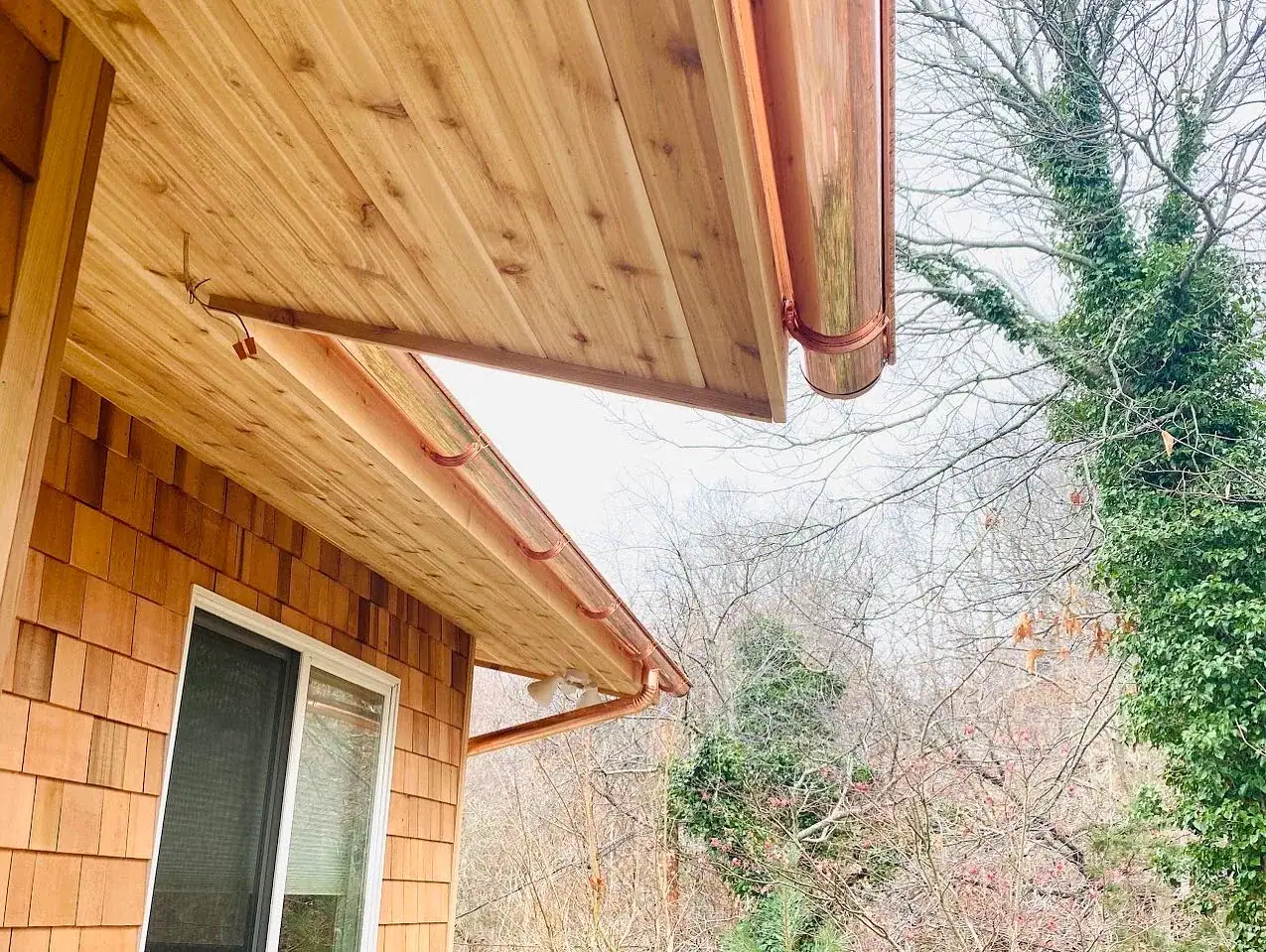
Cedar shake siding is everywhere on Long Island’s East End — drive through East Hampton, Sag Harbor, or Southold and you’ll see it on nearly every block. There’s a reason for that. Cedar has a natural warmth and texture that no manufactured product has fully replicated, and in high-end residential markets like the Hamptons and North Fork, it carries real weight with buyers and appraisers.
That said, cedar is a commitment. It needs to be stained or repainted every three to five years to stay protected, and in Suffolk County’s coastal environment — where salt air, humidity, and freeze-thaw cycles work against any exterior material — skipping that maintenance cycle has consequences. A well-maintained cedar home can last 50 years or more. A neglected one starts showing rot and delamination well before that.
What Cedar Siding Actually Costs on Long Island — and What Affects the Price
Cedar siding across Long Island typically runs between $7 and $13 per square foot installed, though premium clear vertical grain Western Red Cedar can push that figure considerably higher. For a standard 1,800 square foot home, you’re often looking at a total project cost in the $16,500 to $29,500 range depending on the grade of material, the complexity of the install, and how much prep work the existing exterior requires.
Labor costs for cedar installation run higher than vinyl — typically $5 to $8 per square foot — because the work demands more skill and more time. Proper installation means installing a weather-resistant barrier before any siding goes up, flashing every window and door penetration correctly, and priming the cedar before it ever touches the wall. Contractors who skip those steps are the reason cedar gets a bad reputation for rotting prematurely.
There’s also the ongoing cost to factor in. Staining or painting cedar every three to five years costs money and time. On a large home in a coastal area of Suffolk County, that recurring maintenance bill adds up meaningfully over a 20-year period. It’s not a dealbreaker — but it should be part of your math when comparing options.
One thing worth knowing if you’re in the Hamptons or on the North Fork: cedar siding can add five to ten percent to a luxury home’s appraised value when it’s properly maintained. In competitive real estate markets, that matters. The material signals quality and authenticity in a way that resonates with buyers who are already spending at that level. But that premium only holds if the siding looks the part — peeling, graying, or rotting cedar actively works against you.
One last thing that doesn’t come up in most comparison guides: if your home sits in a wooded area of Brookhaven, Smithtown, or inland Huntington, woodpecker damage is a real and recurring problem with cedar siding. It’s not a reason to avoid cedar, but it’s worth knowing before you install it.
How Salt Air and Nor'easters Affect Cedar Siding Performance
Long Island’s coastal climate puts cedar through conditions that most national comparison guides don’t account for. Within a mile or two of the shoreline — whether you’re on the South Shore near Great South Bay, on the North Shore along Long Island Sound, or out on the East End near the Atlantic — salt air accelerates the breakdown of any exterior finish. Cedar that would hold a stain for five years in an inland climate may need attention in three years closer to the water.
Nor’easters are the other variable. Sustained winds of 50 to 80 miles per hour with driving rain test every seam, every fastener, and every piece of flashing on your home’s exterior. Cedar that’s been properly installed — with a solid weather-resistant barrier, correctly lapped panels, and sealed edges — handles these storms well. Cedar that was installed by someone cutting corners on the prep work is a different story. After Superstorm Sandy in 2012, a lot of Suffolk County homeowners learned the hard way that the siding material mattered less than the installation behind it.
The practical takeaway is this: cedar can absolutely perform in Long Island’s coastal environment, but it requires a higher standard of installation than it would in a more forgiving climate, and it requires consistent maintenance to stay that way. If you’re within a mile of the water, budget for more frequent staining intervals and use a contractor who understands what coastal exposure actually means for material selection and prep work.
For homes further inland — say, central Brookhaven or the Smithtown interior — cedar performs closer to its national averages, and the maintenance burden is more manageable. The salt air zone matters, and where your home sits within Suffolk County should factor into your decision.

Vinyl Siding vs Wood Siding: The Honest Comparison
Vinyl siding has a reputation problem it doesn’t entirely deserve anymore. The vinyl being installed today — particularly the insulated, cedar-grain textured options — is a genuinely different product from what went up on homes in the 1980s and 1990s. Premium vinyl holds color, resists moisture, and handles Long Island’s climate without asking much of you in return.
The core trade-off is straightforward. Vinyl costs less upfront, requires almost no maintenance, and still delivers a solid return at resale. National data puts vinyl siding’s cost recouped at around 78 to 80 percent at resale. The maintenance cost difference over 20 years can be significant.
What Vinyl Siding Costs in Suffolk County — and Where It Makes the Most Sense
Vinyl siding in Suffolk County typically runs between $4 and $12 per square foot installed, with the range driven by product grade, profile style, and whether you’re going with standard or insulated vinyl. Insulated vinyl — which adds a foam backing that can boost wall R-value from less than 1 up to R-4 — costs roughly $1.50 to $2.50 more per square foot. On a 1,800 square foot home, that’s an additional $2,700 to $4,500 upfront, but it pays back in lower heating and cooling costs over time.
Labor for vinyl installation runs $2 to $4 per square foot, which is meaningfully lower than cedar. The installation still needs to be done correctly — a weather-resistant barrier is non-negotiable, penetrations need proper flashing, and vinyl panels need to be fastened with enough room to expand and contract with temperature swings. Vinyl that’s nailed too tight buckles in summer heat. These aren’t complicated details, but they separate a 30-year installation from a 10-year one.
Where does vinyl make the most sense in Suffolk County? In the South Shore communities — Bay Shore, Islip, Lindenhurst, Babylon, Amityville — vinyl is the dominant choice, and for good reason. These are practical, year-round communities where homeowners want durability and low maintenance without the premium price tag of cedar. High-grade vinyl in these neighborhoods looks sharp, holds up against the weather, and doesn’t demand anything from you between installations.
Vinyl is also a smart call if you’re planning to sell within the next five to eight years. The upfront cost is lower, the ROI is comparable to cedar, and buyers in most Suffolk County markets respond positively to clean, well-installed vinyl siding. You’re not leaving money on the table — you’re making a financially rational decision.
Best Siding for Coastal Homes on Long Island: What Actually Holds Up
The honest answer is that both cedar and vinyl can perform well on Long Island’s coast — and both can fail — depending almost entirely on installation quality and material grade. The question isn’t really cedar versus vinyl in a vacuum. It’s which material, installed correctly, makes the most sense for your specific home, your location within Suffolk County, and how you plan to maintain it.
For homes right on the water — oceanfront in Southampton, bayfront in Islip, or along the Sound in Northport or Huntington — the salt air exposure is intense enough that we always recommend higher-grade products regardless of material. Standard builder-grade vinyl fades and becomes brittle faster in those conditions. Lower-grade cedar finishes break down more quickly. The coastal premium isn’t just a marketing phrase; it’s a real cost of doing the job right.
If aesthetics are the primary driver and you’re in a neighborhood where cedar is the expected standard — East Hampton, Bridgehampton, Sag Harbor, Cold Spring Harbor, Port Jefferson — then cedar is worth the investment, provided you’re committed to the maintenance. The visual difference between real cedar shake and even the best vinyl imitation is still noticeable up close, and in those markets, it registers with buyers and appraisers.
If you want something that looks clean, holds up in the weather, and doesn’t require you to think about it for 20 to 30 years, premium vinyl installed with proper prep work is a completely defensible choice — even in coastal areas. The key word is premium. There’s a meaningful difference between what a quality contractor installs and what a budget contractor puts up, and that difference shows up years later when one home’s siding is still looking sharp and the other is fading, cracking, or letting water in behind the panels.
One thing we always tell homeowners: get the installation right before you worry about the material. A $10,000 cedar job done poorly will outlast its welcome faster than a $7,000 vinyl job done well.
Which Siding Is Right for Your Long Island Home?
There’s no single right answer here — which is exactly why so many Suffolk County homeowners get stuck on this decision. Cedar is the better choice if you’re in a neighborhood where it’s the aesthetic standard, you’re planning to stay long-term, and you’re willing to maintain it on a regular schedule. Vinyl is the better choice if you want lower upfront costs, near-zero maintenance, and a material that performs reliably across Long Island’s coastal conditions.
What matters most, regardless of which direction you go, is that the installation is done correctly. The weather-resistant barrier, the flashing, the fastening — these are the details that determine whether your siding lasts 10 years or 40. They’re also the details that separate contractors who know Long Island’s climate from those who don’t.
We’ve been installing both cedar and vinyl siding across Suffolk County for over 22 years, and we’ve seen what holds up and what doesn’t. If you’re ready to talk through your specific home and situation, we’re happy to take a look — no pressure, just a straight answer.

Article details:
- Published by:
- Roofing & Chimney Contractor Long Island, NY
- Published to:
- Last modified: October 29, 2026
- October 29, 2026
Share:
Continue learning: