
Commercial Roofing: TPO vs EPDM Explained
TPO and EPDM are the two most common flat roofing systems — but they're not interchangeable. Here's how to tell which one fits your building.
If your commercial building has a flat or low-slope roof, at some point you’re going to face a choice between TPO and EPDM. Most property owners walk into that conversation without a clear sense of what either material actually is — and contractors don’t always take the time to explain it properly. So you end up with a recommendation you can’t fully evaluate, a price you can’t contextualize, and a decision that’s going to affect your building for the next 20 to 30 years. That’s a lot of pressure for a conversation that often lasts ten minutes. This page is here to change that. We’ll walk through both systems honestly, explain where each one makes sense, and give you the local context that actually matters for Suffolk County buildings.
TPO Roofing: What It Is and Why It's Become the Default Choice
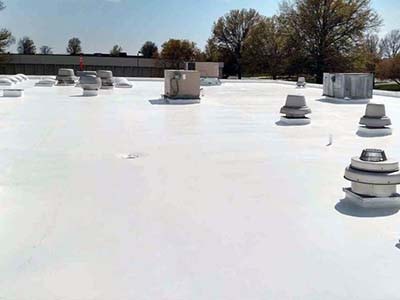
TPO stands for thermoplastic polyolefin — a single-ply membrane that gets rolled out across a flat roof deck and heat-welded at the seams. It’s white, it’s reflective, and over the past decade it’s become the most commonly installed commercial roofing membrane in North America. That didn’t happen by accident.
The reflective surface is a big part of the appeal. On a commercial building with HVAC equipment sitting on a flat roof — which describes a huge percentage of the strip malls, medical offices, and light industrial spaces along the LIE corridor through Suffolk County — a white TPO membrane can meaningfully reduce cooling costs during Long Island’s humid summers. It qualifies as an Energy Star-compliant cool roof, which matters both for energy bills and for meeting New York State’s energy code requirements on new or replacement commercial roofing.
How Long Does TPO Roofing Last — and What Actually Determines That?
The honest answer is: it depends almost entirely on how it was installed. A properly installed TPO roof using 60 mil membrane can last 20 to 25 years. Step up to 90 mil and you’re looking at 25 to 30 years or more. Drop down to 45 mil — which some contractors use to keep their bid competitive — and you might be back to square one in 10 to 15 years.
But membrane thickness is only part of the equation. The seams are where TPO roofs live or die. TPO is a thermoplastic material, which means the seams have to be heat-welded using commercial hot-air welding equipment operated by a trained technician. When that’s done correctly, the welded seam is actually stronger than the membrane itself. When it’s done sloppily — wrong temperature, wrong speed, wrong pressure — the seam looks fine on day one and starts separating in year three.
This is the single most common cause of TPO roof failure, and it’s almost entirely invisible to the untrained eye during a quick walkthrough. A contractor who uses drone video to document the full roof surface before and after installation can catch issues that a manual inspection misses — especially on larger commercial roofs where you’re covering thousands of square feet of membrane.
For Suffolk County commercial properties specifically, there’s another layer to consider: wind uplift. The county’s coastal exposure — bordered by the Atlantic to the south, the Long Island Sound to the north — means higher wind loads than you’d see in an inland market. The installation method matters here too. A fully adhered TPO system, where the membrane is bonded directly to the insulation layer, performs better under wind stress than a mechanically fastened system in high-exposure locations. If your building is near the water — anywhere from the South Shore to the North Fork — that’s a conversation worth having with your contractor before the job starts.
What Does TPO Roofing Cost for a Commercial Building in Suffolk County?
Nationally, installed TPO roofingruns roughly $5 to $15 per square foot, with most commercial projects landing in the $6.50 to $8.50 range depending on membrane thickness, installation method, and the complexity of the roof — how many penetrations, HVAC curbs, drains, and edges need to be properly flashed. For a 10,000 square foot commercial flat roof, that puts you somewhere in the range of $80,000 to $150,000 fully installed.
Those numbers can feel abstract, so here’s what actually moves the needle on cost. Membrane thickness is one factor — thicker costs more upfront but lasts significantly longer, which changes the math when you’re thinking in 20-year windows. Insulation is another — New York State’s energy code sets minimum R-value requirements for commercial roofing, and the insulation layer is not something you want to cut corners on. Then there’s the removal and disposal of your existing roof system, which adds cost but is non-negotiable if the existing substrate is compromised.
The one thing we’d caution against is evaluating bids purely on price per square foot. A contractor who bids low on materials and rushes the seam welding is giving you a number that looks good on paper and costs you a full re-roof in ten years. The real cost of a TPO roof is the installed cost divided by the years of reliable service it actually delivers — and that number is almost entirely determined by the quality of the installation, not the sticker price.
EPDM Roofing: The Proven Alternative That Earns Its Reputation
EPDM has been protecting commercial flat roofs since the 1960s. That’s over 60 years of documented performance across climates, building types, and conditions — a track record that no other flat roofing material can match in terms of sheer longevity of use. Where TPO is the newer, energy-efficient option, EPDM is the one that’s been stress-tested by decades of real-world buildings.
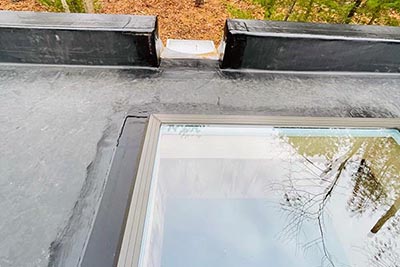
It’s a synthetic rubber membrane — black in its standard form — and it handles thermal movement exceptionally well. Buildings that experience significant expansion and contraction, older structures with complex roof lines, or commercial properties with a large number of penetrations tend to respond well to EPDM’s flexibility. The rubber composition absorbs the stress of freeze-thaw cycles without cracking, which is a meaningful advantage in Suffolk County winters where temperatures regularly drop below freezing and climb back up within the same week.
EPDM Rubber Roofing: How It's Installed and Why That Matters
EPDM rubber roofing can be installed three ways: fully adhered, mechanically fastened, or ballasted. Each method has different performance characteristics, cost implications, and ideal applications.
A fully adhered system bonds the membrane directly to the insulation substrate using a contact adhesive. It’s the most durable installation method, the most resistant to wind uplift, and the most demanding to execute correctly. The adhesive has to be applied in appropriate weather conditions — not too cold, not too wet — and the membrane has to be rolled out and pressed carefully to avoid air pockets or voids that become weak points over time. This is why we say on our own website that a fully adhered EPDM system is particularly tricky to install correctly. It’s not a warning meant to scare you — it’s an honest acknowledgment that this type of installation rewards experience and penalizes shortcuts.
A mechanically fastened system uses fasteners and plates to secure the membrane to the roof deck. It’s faster to install and more tolerant of cold-weather installation windows, but it creates more potential stress points at the fastener locations and generally performs less well under sustained wind loads.
A ballasted system lays the membrane loosely and holds it down with river stone or pavers. It’s the most affordable installation method and the easiest to inspect and repair, but it adds significant weight to the roof structure — something that needs to be evaluated against your building’s load capacity before you commit.
For most commercial properties in Suffolk County, the fully adhered method is the right call. The coastal wind exposure makes proper membrane attachment critical, and the long-term durability of a fully adhered system more than justifies the additional installation cost over the life of the roof.
How Long Does EPDM Last — and Is It Still Worth Choosing Over TPO?
A properly installed, properly maintained EPDM roof lasts 25 to 50 years. The average for a fully adhered commercial system is closer to 25 to 35 years — but there are EPDM roofs on commercial buildings across Long Island that have been performing reliably for 40 years with nothing more than routine maintenance and the occasional seam repair. That kind of documented longevity is genuinely hard to argue with.
The comparison to TPO comes down to a few practical questions. Is energy efficiency a priority? If your building runs significant cooling loads through the summer and you’re looking to reduce operating costs, TPO’s white reflective surface has a real advantage. Is thermal flexibility more important than reflectivity? If your building is older, has a complex roof geometry, or experiences significant structural movement, EPDM’s rubber composition handles that stress better than TPO over the long run.
There’s also a cost consideration that often gets oversimplified. EPDM installed cost runs roughly $6 to $12 per square foot — which overlaps significantly with TPO’s range. Neither material is categorically cheaper. What varies is the total cost of ownership over the full lifespan. A 35-year EPDM roof that costs slightly more upfront may be the more economical choice than a 20-year TPO roof that requires replacement sooner.
One thing worth noting for Suffolk County specifically: salt air from the ocean and sound accelerates degradation of roofing materials, particularly at flashings and adhesive bonds. This makes material quality and installation precision more critical here than in inland markets. Both TPO and EPDM perform well in coastal conditions when installed correctly — but “installed correctly” carries more weight when your building is in Babylon, Islip, or anywhere near the water than it does in a landlocked environment. This is one of the reasons we recommend getting a thorough inspection — including drone documentation of the full roof surface — before committing to any system on a coastal or near-coastal Suffolk County property.
Which Commercial Roofing System Is Right for Your Suffolk County Building?
There’s no single right answer — but there is a right answer for your specific building, your climate exposure, and your long-term budget. TPO makes sense when energy efficiency is a priority, the building is newer and structurally stable, and you want a system that qualifies for Energy Star and meets New York State’s energy code requirements. EPDM makes sense when flexibility and proven longevity matter more than reflectivity, especially on older buildings or structures that see significant thermal movement through Suffolk County’s freeze-thaw winters.
What both systems share is this: their lifespan is almost entirely determined by the quality of the installation. The material choice matters. The installer matters more.
We’ve been doing this work on Long Island for over 22 years, on residential, commercial, and industrial roofs across Nassau and Suffolk Counties. If you’re trying to figure out which system makes sense for your building — or you already know you need a replacement and want a straight answer on what it should cost and how long it should last — reach out to us at Expressway Roofing & Chimney, Inc. We’ll give you an honest assessment, not a sales pitch.
Article details:
- Published by:
- Roofing & Chimney Contractor Long Island, NY
- Published to:
- Last modified: June 30, 2026
- July 1, 2026
Share:
Continue learning: