
Residential Metal Roofing: Copper to Steel
Not all metal roofs are the same. This guide breaks down copper, tin, and corrugated steel so Suffolk County homeowners can make a confident, informed choice.
If you’ve started looking into metal roofing, you’ve probably already noticed that “metal roof” covers a lot of ground — copper, steel, aluminum, tin, corrugated panels, standing seam systems. It’s not a single product. It’s an entire category, and the differences between options are significant enough to affect your home’s appearance, your energy bills, and how long before you ever think about your roof again.
For homeowners in Suffolk County, the stakes are a little higher than most places. Salt air, nor’easters, freeze-thaw cycles, and the occasional tropical storm remnant make roofing decisions more consequential here. This guide covers what you need to know about the main residential metal roofing options — and what actually holds up on Long Island.
Copper Metal Roofing: The Premium Choice for Long Island's High-End Homes
Copper roofing sits at the top of the residential metal roofing spectrum — in cost, in longevity, and in visual impact. A properly installed copper roof can last well over 100 years. That’s not marketing; historic copper roofs across New England and Europe have been standing for centuries, and the material’s performance in coastal, high-humidity environments is well documented.
For Suffolk County homeowners — particularly on the East End, in the Hamptons, or along the North Shore — copper is often the material that matches the architecture. It doesn’t just perform; it belongs. And because copper develops its signature blue-green patina gradually over years, what you’re really getting is a roof that improves with age rather than one that slowly degrades.
Why Copper Roofing Holds Up So Well in Coastal Suffolk County
The salt air that rolls in off the Atlantic, the Great South Bay, and Long Island Sound is one of the most corrosive environments a roof can face. Standard galvanized steel corrodes faster in this kind of exposure. Aluminum holds up better. Copper is essentially immune to it — salt air doesn’t degrade copper the way it attacks other metals. That’s a meaningful advantage when your home is within a few miles of the water, which describes a large portion of Suffolk County.
Beyond corrosion resistance, copper has a natural antimicrobial quality that prevents the moss, algae, and biological growth that gradually breaks down other roofing materials. If you’ve ever seen dark streaking on an asphalt roof, that’s algae. You won’t see it on copper.
Installation is where copper separates the experienced contractors from the rest. Working with copper requires specialized fabrication skills — proper seaming, soldering at penetrations and valleys, and flashing details that account for the metal’s thermal expansion. Done right, the installation is nearly seamless and virtually maintenance-free for decades. Done poorly, you’ll have leaks at the exact spots where the craftsmanship failed.
The cost reflects the material and the skill required. Copper roofing typically runs $20–$35 per square foot installed, and a full replacement on a 2,500-square-foot home can reach $50,000–$87,500 depending on roof complexity. That’s a real number, and it’s worth being honest about. But when you’re comparing it against replacing an asphalt roof two or three times over the same period — each time at $15,000–$30,000 — and factoring in the energy savings and zero maintenance costs, the math gets a lot more interesting.
One more thing worth mentioning: copper isn’t just for the roof panels. Copper gutters, copper chimney caps, and copper flashing can complete the exterior as a unified system. We install all of it, which means one contractor, one warranty, and no gaps between trades.
What the Patina Process Actually Looks Like Over Time
A lot of homeowners hesitate on copper because they’re not sure what they’re signing up for aesthetically. The patina process is gradual and predictable. Fresh copper has a warm, bright metallic appearance — similar to a new penny. Over the first few years, it deepens to a rich chocolate brown. Then, over the following years or decades depending on climate and exposure, it transitions to the iconic blue-green verdigris that defines copper roofing on historic buildings.
In Suffolk County’s humid, coastal climate, that patination process tends to happen faster than in dry inland environments — which means you’ll see the full character of the roof sooner. Some homeowners love watching it evolve. Others want to preserve a specific stage of the patina. There are coatings available that can stabilize the appearance at a particular point if that matters to you.
What the patina actually does, beyond looking distinctive, is form a protective oxide layer on the surface of the copper. That layer actively shields the metal from further corrosion. So the aging process isn’t degradation — it’s the roof building its own defense system. A copper roof in its patina stage is more protected than a new one, not less.
For homes in East Hampton, Southampton, Bridgehampton, or along the North Shore, copper roofing is a natural fit architecturally. The material has been used on high-end residential and institutional buildings in the Northeast for centuries. It doesn’t look out of place on a Long Island estate — it looks exactly right. And in a real estate market where median home values in Suffolk County sit above $600,000, a roof that adds prestige and permanence is worth taking seriously.
Tin Roofing: What That Term Actually Means Today
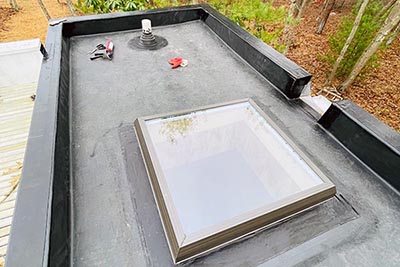
“Tin roofing” is one of those terms that means something different to your contractor than it might to you. If you’re picturing the old corrugated tin roofs from a century ago, the material has changed significantly — but the name stuck. Today, when someone says “tin roof,” they almost always mean steel: either galvanized steel or Galvalume-coated steel, which is an alloy of zinc and aluminum applied to the surface to prevent rust.
True tin roofs — made from actual tin — are historical artifacts at this point. Thomas Jefferson had a standing seam tin roof on Monticello. The material was common in the 19th century because it was lightweight, relatively inexpensive, and easy to form. Modern steel roofing carries that same practical lineage forward with far better engineering behind it.
Galvanized vs. Galvalume Steel: Why the Coating Matters on Long Island
For Suffolk County homeowners, the distinction between galvanized steel and Galvalume steel is more than a technical detail — it’s the difference between a roof that holds up for decades and one that starts showing corrosion within a few years of installation.
Standard galvanized steel is coated with zinc to prevent rust. It’s the most common and most affordable steel roofing option, and it performs well in most environments. In coastal environments, though — and Suffolk County is about as coastal as it gets — the salt air accelerates the breakdown of zinc coatings over time. Homes within a few miles of the Atlantic, the Sound, or the Bay are particularly vulnerable.
Galvalume steel uses a zinc-aluminum alloy coating that significantly outperforms standard galvanized in salt-air environments. The aluminum component in the coating creates a more stable, corrosion-resistant barrier. For Long Island homes, Galvalume is the smarter default unless you’re going with aluminum or copper. It costs a bit more upfront, but it holds up far better in the conditions you’re actually dealing with.
Steel roofing comes in a wide range of profiles — standing seam, architectural panels, and corrugated — and a wide range of gauges. Gauge refers to the thickness of the steel, and this is where a lot of homeowners get confused. Lower gauge numbers mean thicker steel. A 24-gauge panel is thicker and more durable than a 29-gauge panel. For residential applications in coastal areas, 24-gauge or 26-gauge is generally the right call. Thinner panels are more susceptible to oil-canning — the visible waviness that can develop when metal panels aren’t thick enough to hold their shape under thermal stress.
The price range for steel roofing is broad: roughly $4–$21 per square foot depending on the profile, gauge, coating, and finish. Standing seam systems with concealed fasteners sit at the higher end of that range and offer superior weather tightness. Exposed fastener systems are more economical but require periodic inspection to ensure the fasteners haven’t loosened or allowed water infiltration.
Corrugated Steel Roofing for Suffolk County Homes: Practical, Durable, and Back in Style
Corrugated steel roofing has been around since the 1820s, and it’s had a genuine resurgence in residential architecture over the past decade. The wavy, ribbed panel profile that was once associated almost exclusively with agricultural buildings and industrial structures is now a deliberate design choice on modern farmhouse homes, coastal cottages, and contemporary builds across Long Island’s East End.
The practical case for corrugated steel is straightforward. It’s one of the most cost-effective metal roofing options available, it installs quickly, and when coated with Galvalume or a high-quality PVDF finish, it holds up well in coastal environments. It’s also lightweight relative to its strength, which matters on older homes where the structural load capacity of the roof deck is a consideration.
The aesthetic case has become equally compelling. In communities like Wading River, Riverhead, and the more rural parts of eastern Suffolk County, the corrugated profile fits naturally into the landscape. For homeowners who want the durability of metal roofing without the formality of standing seam or the investment of copper, corrugated steel hits a practical middle ground that makes a lot of sense.
One thing to understand about corrugated panels is that they use exposed fasteners — meaning the screws that attach the panels to the roof deck are visible from outside. This is standard for the product and not a flaw, but it does mean those fasteners need to be inspected periodically. The rubber gaskets around exposed fasteners can degrade over time, particularly in high-UV coastal environments, and a loose or degraded fastener is one of the more common entry points for water. It’s a manageable maintenance consideration, not a dealbreaker — but it’s worth knowing going in.
For homeowners who want the corrugated look with hidden fasteners, there are hybrid panel systems that achieve a similar ribbed aesthetic using concealed attachment methods. These cost more but eliminate the fastener maintenance concern entirely. It’s worth discussing with your contractor which approach makes sense for your specific roof geometry and budget.
Choosing the Right Metal Roof for Your Suffolk County Home
The honest answer is that there’s no single best metal roofing material — there’s the right one for your home, your budget, your location in Suffolk County, and how long you plan to stay. Copper is the right answer for a waterfront estate in East Hampton where longevity and aesthetics are the priority. Galvalume standing seam steel is the right answer for a South Shore home that needs storm-rated performance and energy efficiency without the copper price tag. Corrugated steel is the right answer for a modern farmhouse build in Riverhead where the profile is part of the design intent.
What all three have in common is that they outlast asphalt by decades, hold up in coastal conditions that shorten the life of most roofing materials, and — when installed correctly — require very little from you after the job is done. That last part depends entirely on who installs it.
We’ve been doing this work on Long Island for over 22 years, exclusively in Nassau and Suffolk Counties. We know what holds up here and what doesn’t. If you’re weighing your options and want a straight answer, reach out to Expressway Roofing & Chimney, Inc. — we’re happy to walk through it with you before you make any decisions.
Article details:
- Published by:
- Roofing & Chimney Contractor Long Island, NY
- Published to:
- Last modified: July 2, 2026
- July 2, 2026
Share:
Continue learning: